Aceites lubricantes

Aceites
lubricantes

Los aceites lubricantes son sustancias de alto rendimiento que, al igual que las grasas lubricantes, contribuyen a reducir la fricción mecánica y el desgaste con la formulación adecuada. Desde un punto de vista estrictamente químico, los aceites lubricantes son mezclas que constan básicamente de dos componentes: Aceite base + aditivos
Imagen 1
Catálogo Interactivo de Lubricantes Industriales
23 productos
Producto Base Aplicación sugerida Índice Visc. Rango Operación Flash point Pour point Densidad

Especificaciones técnicas certificadas para lubricación en alta demanda industrial.

Producto estrella / recomendado

NGSH-68

NGSH-68

SKU: 1234456789

Descargables

Imagen 1

Propiedades

Característica Valor
Capacidad demulsificante 40/38/2 (10) (min)
Densidad 0.87 g/cm³
Flash point 250°C
Viscosidad cinética, 100°C Aprox. 10 mm²/s
Viscosidad cinética, 40°C Aprox. 65 mm²/s
Índice de viscosidad 150
Pour point -54°C
Vida útil, condiciones opt. 36 meses
Temperatura de operación
Aplicación sugerida

Índice de viscosidad

25 23 21 19 17 15 13 11 9 7 5 3 1 -1 Categoría 1 Categoría 2 Categoría 3 Categoría 4

No matter where your gas compressor operates, we are specialists for its effective lubrication

Whether for on- or off-shore applications, whether for the extraction of oil or gas, for refineries, the chemical or petrochemical industry – special lubricants are offered that are precisely tuned to your needs and the types of gases in your compressor.

We regard the lubricant as an essential design element of the compressor, just as bearings, rotors or slide valves. More than 80 years of practical experience in research, development and application of special lubricants ensure a product quality that increases the reliability, availability and production capacity of compressors. These benefits enable maximum asset performance in particular in the oil and gas industry where the cost of downtime and machine failure is extremely high.

Many compressor shut-downs due to wear?

With the right lubricating oil you will not only reduce wear and increase the life of individual components as well as that of your machines as a whole, but you will also boost your operational reliability and hence your profits. But which lubricating oil will release this potential?

Lubricating oils in rotary screw-type compressors for process gases fulfil a number of different tasks:

  • They lubricate the rotors and the bearings.
  • They seal the gap between rotor and casing, and between the rotors.
  • They cool the gas stream being compressed.
  • They remove heat.
  • They protect against corrosion.

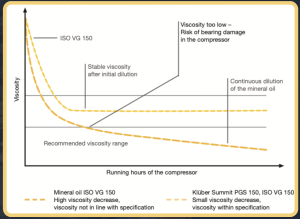
Viscocity Calculation

Every gas stream is unique.
Each gas has a different tendency to be dissolved in lubricating oil. All factors determining this tendency must be taken into account, including the actual operating conditions:

1. Pressure
The higher the compression, the higher the tendency of the gas to be dissolved in the oil.

2. Temperature
The higher the compression temperature, the lower the tendency of the gas to be dissolved in the oil.

3. Molecular
weight The higher the molecular weight of the gas, the higher its tendency to be dissolved in the oil. “Heavy ” hydrocarbons such as toluene are more easily dissolved than “light” ones such as methane or propane.

4. Polarity
When it comes to polarity, the principle of “likeness ” applies. Polar gases such as ammonia are easily dissolved in polar oils such as polyglycol, while non-polar gases such as hydrocarbons are less easily dissolved in polar oils. Taking these criteria into account, the tendency of a gas to be dissolved in lubricating oil can be calculated before the rotary screw compressor is filled with lubricant. This provides valuable information about oil viscosity under actual operating conditions and helps ensure that the lubricant meets the manufacturer ’ s viscosity requirements in real-life situations.